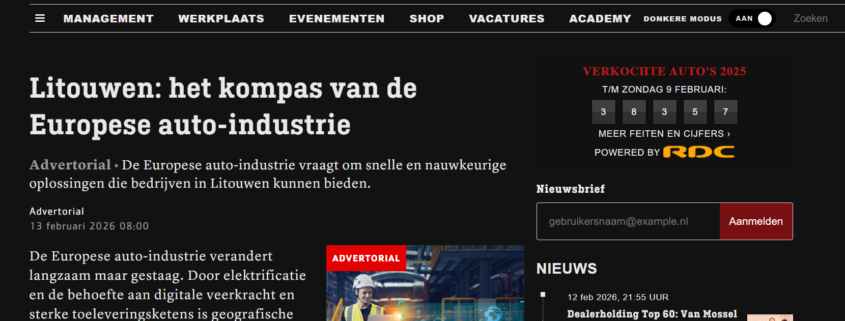
Lithuania’s Mobility Ecosystem Featured in Czech Automotive Media – Now on Garaž.cz

Our outreach to key European automotive markets continues. Following recent publications in Western Europe, the same in-depth article presenting Lithuania’s automotive and mobility ecosystem has now been published on Garáž.cz – one of the Czech Republic’s most influential automotive platforms.

Why does this matter?

The Czech Republic is one of Europe’s strongest automotive manufacturing hubs, deeply integrated into EU supply chains and highly export-oriented. For BAMC, visibility in this market is not only about awareness – it is about positioning Lithuania as:

• A reliable EU-based engineering and manufacturing partner
• A flexible and innovation-driven ecosystem
• A strategic location connecting Central Europe and Scandinavia
• A growing hub for electrification, smart mobility and advanced manufacturing

As Europe’s automotive industry restructures around resilience, electrification and digitalisation, cross-border cluster cooperation becomes increasingly important. Our goal is clear: to strengthen industrial bridges between the Baltic region and Central Europe, and to ensure that Lithuania is seen not as a peripheral supplier, but as a strategic contributor to next-generation mobility value chains.

More partnerships. More integration. More European collaboration.

We continue expanding BAMC’s visibility across Europe – this time in another major automotive powerhouse: the Czech Republic 🇨🇿

We’ have just published an article about the Baltic automotive and mobility ecosystem on one of the country’s leading news portals, @Novinky.

This is another important step in building stronger connections with Czech OEMs, and other hashtag#Tier-1 suppliers and mobility innovators, and positioning Lithuania as a reliable partner in Europe’s evolving automotive supply chains.

BAMC, Baltic Automotive and Mobility Cluster is stepping confidently into Western Europe.

As highlighted in our recent Dutch publication, Lithuania’s mobility ecosystem has reached a strategic turning point.

The Baltic Automotive & Mobility Cluster (BAMC) unites a dynamic community of members and is connected to a broader Baltic ecosystem of over 200 companies and research institutions across the automotive value chain.

Why bring this message to the Netherlands?

First, the Dutch automotive and mobility ecosystem is highly innovation-driven, strongly focused on electrification, smart mobility and resilient supply chains – exactly the areas where Lithuania has proven capabilities. Global players such as AUMOVIO, FORVIA HELLA, ABB and Littelfuse have already validated Lithuania as a reliable EU-based production and engineering location.

Second, Lithuania combines hashtag#Tier-1 level standards with agile, high-tech engineering companies.
From precision CNC machining (Baltec CNC Technologies) to e-mobility powertrains (Elinta Motors), advanced electronics (Teltonika Telematics, TLT Manufacturing) and specialized vehicle solutions, our ecosystem delivers speed, flexibility and engineering depth – key factors for Western European OEMs and suppliers seeking strategic partners.

Third, logistics and proximity matter.
Positioned between Central Europe and Scandinavia, with strong sea, road and air connections, Lithuania enables efficient integration into European supply chains while maintaining cost competitiveness within the EU regulatory framework.

The conclusion is clear: Lithuania is an emerging strategic hub for next-generation European automotive and mobility supply chains – and BAMC is ready to build strong partnerships in the Netherlands.

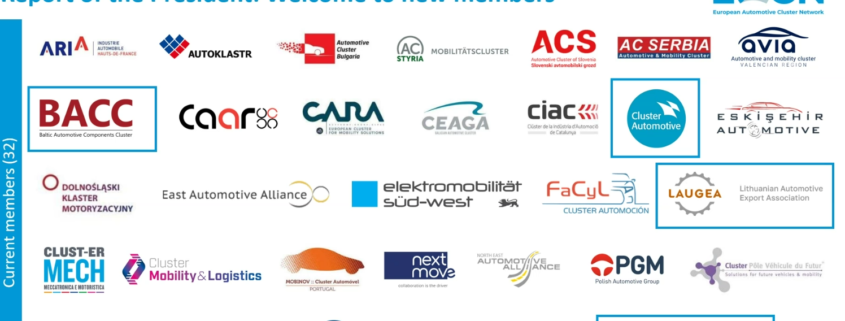
Last week, BACC proudly participated in the 2025 General Assembly of the European Automotive Cluster Network (EACN), bringing together 32 automotive clusters from 17 European countries.

As confirmed during the Assembly (21 January 2025, online), the network continues to grow and strengthen its European footprint

We are honoured that BACC is part of this strong and forward-looking community.

Key highlights from the General Assembly:

🔹 Approval of 2024 activities and 2025 direction
The Report of the President and the Financial Report 2024 were unanimously approved, closing the year with a positive financial result and a solid basis for 2025.

🔹 Executive Board elections (2025–2026)
With 32 member clusters, 11 representatives were elected to the new Executive Board, reinforcing EACN’s governance and strategic capacity

🔹 Strong European engagement in 2024
The President’s Report highlighted EACN’s active role during the European Cluster Conference in Brussels, the launch of mobility meta-cluster cooperation (EACN, EACP, ENMC, ERCI), and extensive exchanges through newsletters, Coffee Breaks and working groups

🔹 Strategic discussion: The situation of the European Automotive Industry
An open debate addressed critical topics shaping our sector:

  • EV market demand challenges

  • The impact of Chinese BEV imports and EU duties

  • Supply chain resilience and plant relocations

  • The need for investments in charging infrastructure and affordable energy

The message was clear: Europe must act decisively to safeguard competitiveness while accelerating the green transition

CIE LT Forge digitalizes

2025-01-14, Marijampole

Rapid Steps Towards a Smart, Digitized Industry: CIE LT Forge Achieves Remarkable Digital Maturity

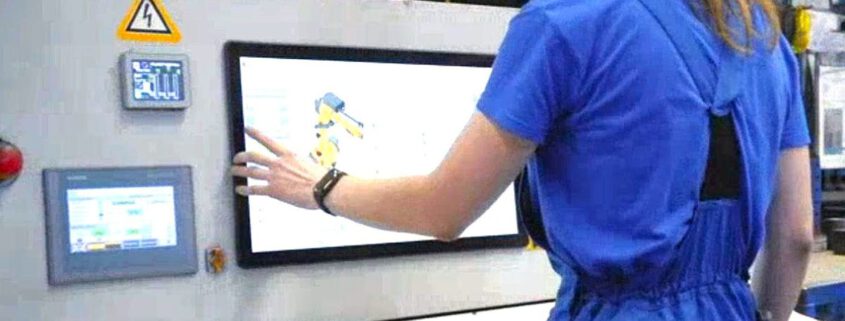
The Baltic Automotive Components Cluster (BACC) proudly celebrates the significant digital progress made by one of its members, CIE LT Forge, which has now reached a remarkable level of digital maturity. The company’s achievements have far surpassed the average digital maturity levels of both metal processing and industrial manufacturing companies in Lithuania (34%) and across the EU (44%).

What fueled this impressive progress over the past year?

Aurelijus Šeštokas, Continuous Improvement and Safety Manager at CIE LT Forge, highlights three key factors that have driven the company’s success:

Data Digitization: Sensors have been integrated into the technological production process to collect both quantitative and qualitative data. Real-time data monitoring, input, and analysis are now possible at workstations, replacing paper-based processes.

Artificial Intelligence: AI-powered visual recognition systems have been introduced to inspect specific parameters of select products, enhancing product quality control.

Automation: CIE LT Forge has utilized robotic lines for over a decade, and this year, the company has further advanced by robotizing two additional forging lines.

Digital Maturity Evaluation

The company’s digital maturity was evaluated using a specialized questionnaire as part of the European Digital Innovation Hub project. This thorough assessment showcases CIE LT Forge’s commitment to technological innovation and operational efficiency.

Why It Matters

Digitalization at CIE LT Forge significantly enhances operational capabilities, efficiency, and competitiveness, positioning the company as a leader in the industry. The Baltic Automotive Components Cluster (BACC) is proud to support its members in embracing smart, cutting-edge technologies that drive progress and innovation across the industry.

At BACC, we remain committed to supporting our members in their digital transformation journey, helping to create a more sustainable, efficient, and globally competitive automotive and mobility industry.

About Baltic Automotive Components Cluster (BACC)
BACC is a leading organization supporting the development and digitalization of the automotive and mobility industry in the Baltic region. Through collaboration, innovation, and technological advancement, BACC members are at the forefront of shaping the future of the automotive sector.


2025-01-07, Vilnius

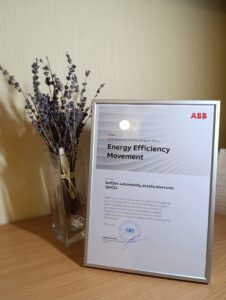
The Baltic Automotive Components Cluster (BACC) has become a member of the global Energy Efficiency Movement, an initiative launched by ABB to promote energy efficiency and sustainable practices across industries. This collaboration aims to enhance the competitiveness of the automotive sector in Lithuania and the Baltic states by sharing knowledge and implementing innovative solutions.

About Energy Efficiency Movement:

The Energy Efficiency Movement is a global initiative launched by ABB, bringing together organizations committed to reducing energy consumption and carbon emissions. It fosters collaboration, knowledge sharing, and the adoption of innovative energy-efficient solutions across various industries. With over 560 members worldwide, it aims to accelerate the transition to sustainable industrial operations.

Statements from Leadership:

  • Diana Manko, Executive Director of BACC, emphasized the importance of this collaboration: “We believe that joining the Energy Efficiency Movement will enable us to provide greater value to our members by disseminating relevant information and fostering initiatives that enhance the competitiveness of the automotive industry in our region.”
  • Justinas Pesliakas, Head of ABB’s Drives and Motors Business in Lithuania, welcomed BACC’s participation: “The inclusion of BACC in the Energy Efficiency Movement is a significant step towards strengthening our collective efforts to promote sustainable solutions in the industry. Together, we can implement innovative ideas that reduce energy consumption and increase competitiveness both locally and internationally.”

Sustainability Initiatives by BACC Members:

  • Astra LT, one of Lithuania’s oldest metal processing companies, has implemented energy-generating building walls that produce approximately 120,000 kWh annually, reducing CO₂ emissions by about 55 tons per year.
  • Hi-steel, a leading metal processing company in the Baltic states, has expanded its solar power capacity and plans to fully electrify its production and logistics equipment, aiming to significantly reduce fossil fuel consumption.


About Baltic Automotive Components Cluster (BACC)
The Baltic Automotive Components Cluster (BACC) is dedicated to fostering innovation, collaboration, and growth within the automotive and mobility sectors across the Baltic region. By connecting industry leaders, innovators, and experts, BACC creates a platform for the exchange of knowledge and drives the future of the automotive ecosystem.

2024-12-12

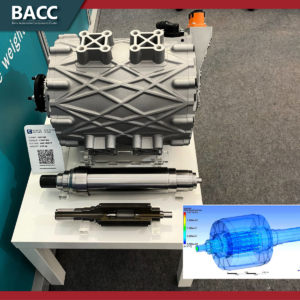
Elinta Motors, a leading innovator in electric motor design, is proud to announce a groundbreaking advancement in electric motor technology, in collaboration with Walter Henrich GmbH. This new development features a unique integration of Walter Henrich GmbH’s advanced Quick’n Cool technology and a zero-porosity rotor, offering an unprecedented leap toward sustainable and efficient motor solutions.

The new motor is:

  • Free from rare-earth materials, aligning with global efforts to reduce dependence on these scarce resources and promote environmental sustainability.
  • 100% Made in Europe, underscoring Elinta Motors’ commitment to local innovation and manufacturing excellence.
  • Equipped with a liquid-cooled shaft, enhancing performance, extending bearing life, and enabling higher continuous power output for more reliable, durable operations.

This breakthrough represents a significant step forward in the electric motor industry, offering not only improved efficiency but also contributing to a greener future for the mobility sector.

Elinta Motors continues to push the boundaries of innovation, pioneering a more sustainable and efficient future for the electric motor industry. By embracing new technologies and design strategies, Elinta Motors is reshaping the future of mobility, one motor at a time.

About Elinta Motors
Elinta Motors is a European leader in electric motor design, committed to driving innovation, sustainability, and efficiency in the mobility sector. Their cutting-edge solutions focus on advancing the performance and environmental sustainability of electric motors.

About Walter Henrich GmbH
Walter Henrich GmbH specializes in providing advanced cooling technologies, with a focus on improving the efficiency and lifespan of electric motors and other high-performance systems.

About Baltic Automotive Components Cluster (BACC)
The Baltic Automotive Components Cluster (BACC) is dedicated to fostering innovation, collaboration, and growth within the automotive and mobility sectors across the Baltic region. By connecting industry leaders, innovators, and experts, BACC creates a platform for the exchange of knowledge and drives the future of the automotive ecosystem.

2024-12-06, Vilnius

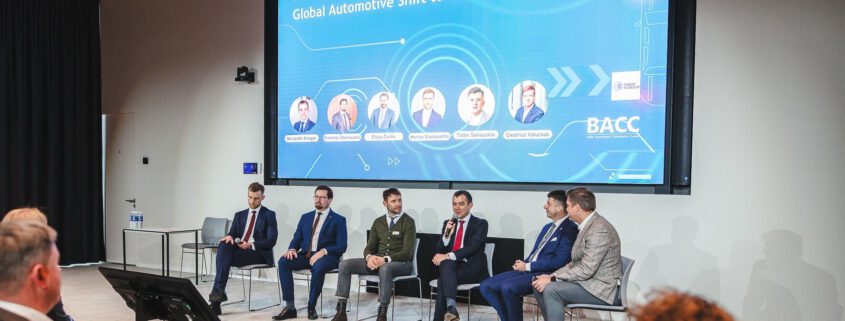
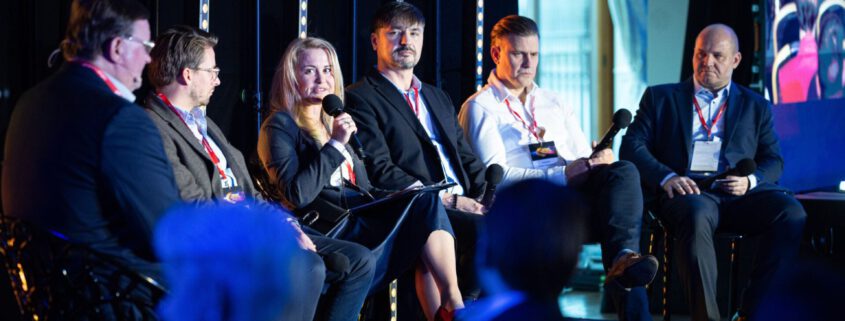
Last week at the Verslo Žinios Transport and Logistics Forum, we engaged in a lively panel discussion with thought-provoking questions from Arunas Bertasius. The conversation covered various topics from managing freight tariffs and client demands to the increasingly heated debate around electric vehicles (EVs).

Will the EV revival stick this time?

History has shown that EVs have experienced cycles of boom and bust. In the late 19th century, electric vehicles dominated the market until innovations in gasoline-powered internal combustion engines (ICEs), cheaper fuel, and the lack of infrastructure caused EVs to lose their foothold.

Fast forward to today—the stakes are higher than ever. Developing affordable batteries with larger capacity and accelerating infrastructure growth are key challenges. While some see EVs as the undeniable future, the big question remains: When will they fully take over?

It was a pleasure to share insights and ideas on this fascinating topic alongside Artūras Ščerbakovas, Mindaugas Jurčiukonis, Justas Baltrusis-Baltrusaitis, and, of course, Tomas Jaskelevicius, one of the BACC founding members.

Let’s keep the conversation going—what do you think needs to happen to ensure EVs truly become the future of mobility?

About Baltic Automotive Components Cluster (BACC)
The Baltic Automotive Components Cluster (BACC) is dedicated to fostering innovation, collaboration, and growth within the automotive and mobility sectors across the Baltic region. By connecting industry leaders, innovators, and experts, BACC creates a platform for the exchange of knowledge and drives the future of the automotive ecosystem.

2024-11-26

The Baltic Automotive Components Cluster (BACC) is proud to announce that it has officially become a member of Drive Sweden, a leading cross-functional collaboration platform dedicated to advancing sustainable mobility.

With a focus on leveraging digital technologies to enable connected, automated, and shared vehicles, Drive Sweden brings together a diverse group of stakeholders from the automotive, tech, and mobility sectors. This collaboration platform is focused on promoting innovative solutions and addressing the challenges currently facing the mobility industry.

As a new member, BACC is excited to join this cutting-edge ecosystem and contribute to shaping the future of mobility. Together with Drive Sweden, we aim to drive forward innovation, sustainability, and progress in the automotive industry.

Our involvement with Drive Sweden aligns with BACC’s mission to foster collaboration and innovation in the Baltic automotive sector. This partnership opens up new opportunities to work with industry leaders, share knowledge, and accelerate the development of solutions that will define the future of transportation.

Let’s shape the future of mobility – together!

About Baltic Automotive Components Cluster (BACC)
The Baltic Automotive Components Cluster (BACC) is committed to fostering innovation, collaboration, and growth within the automotive and mobility sectors across the Baltic region. By connecting industry leaders, innovators, and experts, BACC creates a platform for the exchange of knowledge and drives the future of the automotive ecosystem.

About Drive Sweden
Drive Sweden is a Swedish cross-functional collaboration platform that brings together stakeholders from various sectors to create sustainable and innovative solutions in the mobility field. By working across industries, Drive Sweden aims to accelerate the transformation of transportation through connected, automated, and shared vehicles.

2024-11-20

The Baltic Automotive Components Cluster (BACC) is excited to announce the second edition of its Automotive Webinar Series, dedicated to the automotive and mobility community in the Baltics. This session will focus on the UK automotive market and the future of electric vehicles (EVs)—one of the most discussed and debated topics in the industry today.

The webinar will feature distinguished speakers from the Society of Motor Manufacturers and Traders (SMMT), including:

  • Ruta Aisthorpe: Providing a comprehensive market overview, with insights into UK registrations and automotive manufacturing trends.
  • David Wong: Discussing the latest trends in electrification, mobility solutions, and the challenges faced by the industry as the UK adapts to the changing landscape.
  • Matthew Smith: Sharing insights into UK flagship activities for 2025, continuing the conversation he initiated at the Baltic Automotive Forum 2024.

Webinar Details:
Date: 28th November, 2024
Time: 13:30 (GMT)
Platform: Microsoft Teams

About Baltic Automotive Components Cluster (BACC)
The Baltic Automotive Components Cluster (BACC) is dedicated to fostering innovation, collaboration, and growth within the automotive and mobility sectors across the Baltic region. By connecting industry leaders, innovators, and experts, BACC creates a platform for the exchange of knowledge and drives the future of the automotive ecosystem.